
Performance Report
2025

PHOTO CAPTION: Solar Nanay trainees perform routine solar panel maintenance. Through Upgrade Energy Philippines’ Solar Nanay Program, women in host communities gain technical skills and access to opportunities in the renewable energy sector. The program, championed by President and CEO Ruth Yu-Owen, earned national recognition through the inaugural Women in RE (Renewable Energy) Award at the Philippine Department of Energy Sustainability Awards 2025.
Across ADI’s priority markets, demand for investment remained strong during 2025. In the Philippines, economic growth, a large, underserved SME base and greater policy attention to financial inclusion and digitalisation created favourable conditions for investment. Vietnam continued to attract foreign investment, with opportunities across manufacturing, technology, renewable energy and energy efficiency. In the Pacific, growing attention to renewable energy and climate resilience created further opportunities.
Capital flows remained constrained. Longer fundraising cycles, greater investor caution and limited risk capital delayed fund closes and slowed deployment, particularly in Indonesia. Emerging and impact-focused funds faced similar pressures across the region.
ADI responded by supporting fund capitalisation, engaging co-investors and using flexible financing structures to address investment risk. Technical assistance supported fund managers and portfolio companies to strengthen governance, investment readiness and execution.
Through seven fund investments, ADI indirectly supported 50 active portfolio companies, up from 37 in 2024. These companies supported 25,901 jobs and reached 37.5 million individual clients. The report concludes that ADI’s 2025 performance reinforced its role as a catalytic investor and market builder, mobilising capital while strengthening the systems required for sustainable, inclusive growth.
Australian Development Investments: Mobilising Capital, Strengthening Markets and Enabling Commercial and Development Outcomes
Since inception, ADI has committed AU$39.28 million and mobilised AU$181.45 million in private capital, achieving a mobilisation ratio of 1:4.6. Table 1 records no additional private capital mobilised during 2025, when longer fundraising cycles and greater investor caution affected fund closes and deployment.
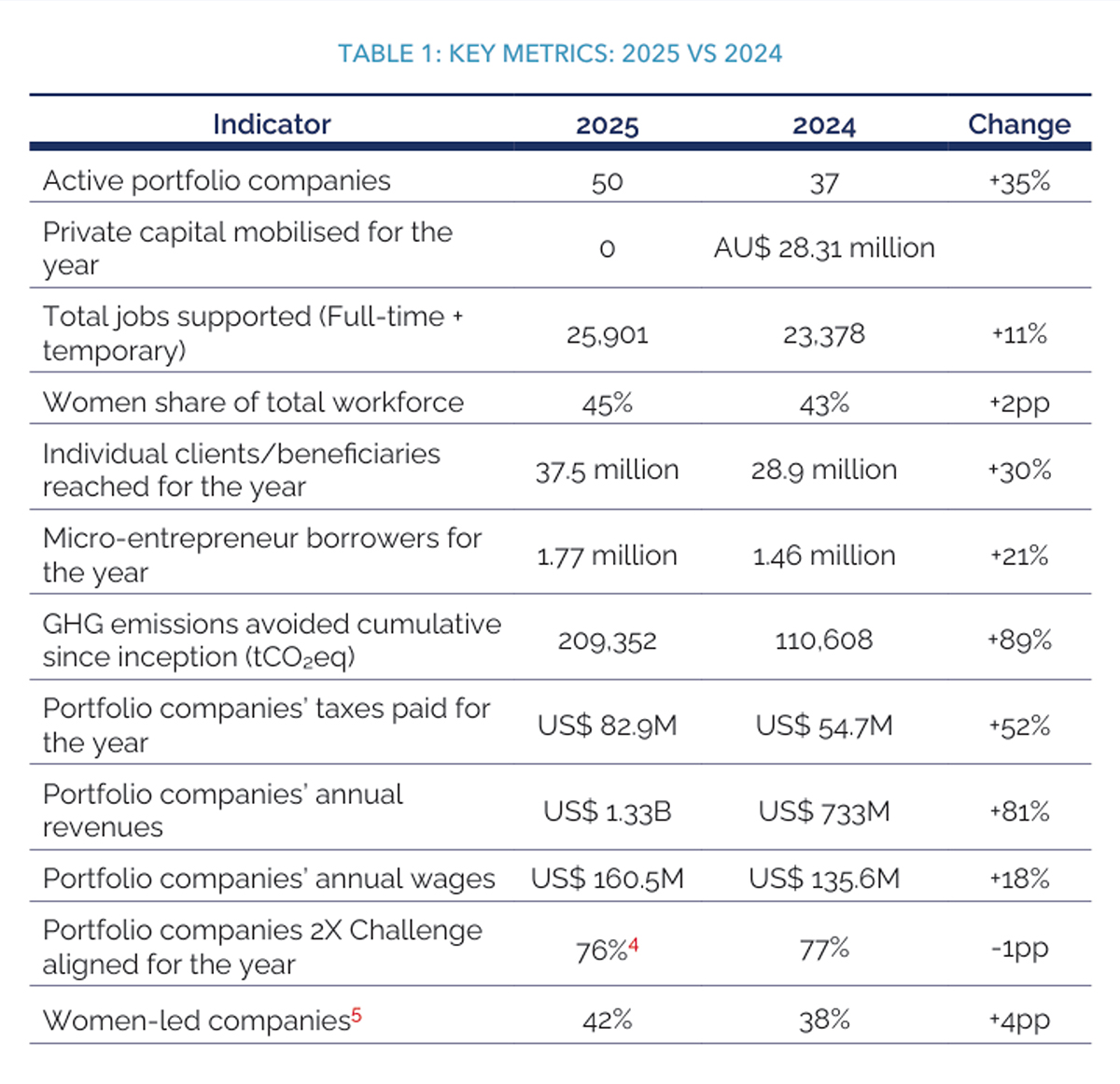
Through seven fund investments, ADI indirectly supported 50 active portfolio companies, up from 37 in 2024. During 2025, these companies generated US$1.33 billion in revenue, paid US$82.9 million in taxes and distributed US$160.5 million in wages.
Portfolio companies supported 25,901 jobs and reached 37.5 million individual clients. Of the 45 companies with sufficient gender data, 76% met the 2X Challenge criteria. The Southeast Asia Clean Energy Facility II (SEACEF II) portfolio had avoided a cumulative 209,352 tCO₂eq by the end of the reporting period.
ADI continued to use blended finance mechanisms to attract investment into underserved markets. Across two first-loss transactions, ADI achieved a mobilisation ratio of 1:8.77. The Climate Catalyst Window, launched in 2025, created a pathway for anchoring climate-aligned funds and mobilising private capital from Australian investors.
Technical assistance supported fund managers and portfolio companies to strengthen governance, investment readiness and execution. To-date, 17 companies had received technical assistance, while all ADI fund managers had established ESG frameworks by the end of 2025.
Expanding access to finance for underserved SMEs
ADI expanded its financing approach in 2025. Asia Business Builders Fund II began active deployment, and ADI completed its first direct loan transaction.
Through the Investing in Women window, Asia Business Builders Fund II is targeting seven to ten women-owned and women-led SMEs in Vietnam.
In the Philippines, ADI provided a US$3 million local-currency loan to ARQ Capital SME Finance. The structure increased ARQ’s capacity to finance underserved SMEs without passing foreign exchange risk to ARQ or its borrowers. ARQ deployed the capital across six SMEs that met the 2X Challenge criteria.
Portfolio reach and economic contribution
ADI portfolio companies generated US$1.33 billion in revenue in 2025, up from US$1.06 billion in 2024. They paid US$82.9 million in taxes, compared with US$54.7 million the previous year. They also distributed US$160.5 million in wages, up from US$135.6 million.
Combined portfolio EBITDA reached US$51 million. The portfolio recorded a net loss of US$46 million as growth-stage companies continued to invest in business expansion and market penetration.
Portfolio companies supported 25,901 jobs, including 13,264 full-time positions. Women represented 45% of the workforce, up from 43% in 2024. Among the 45 reporting companies, 73% provided health insurance and 64% offered maternity leave. Other benefits included dental and disability coverage, flexible working arrangements, parental leave, retirement provisions, and employee ownership schemes.
Portfolio companies reached 37.5 million individual clients, compared with 28.9 million in 2024. They also served approximately 99,800 corporate and SME clients. The increase in individual clients was predominantly driven by Amartha, an Indonesian financial services company in the Lendable portfolio.
Financial services companies reached 1.77 million micro-entrepreneurs and borrowers, 99% of whom were women. Healthcare companies accounted for more than 30.1 million individual clients. Across the wider portfolio, companies also expanded access to education, renewable energy, technology, and agricultural services.
These results capture the portfolio’s commercial growth and its contribution to employment, wages, public revenue and access to essential services across ADI’s markets.
Advancing gender-lens investing
Of the 45 portfolio companies with sufficient gender data, 34, or 76%, met the 2X Challenge criteria. This remained broadly consistent with the 77% reported in 2024 as the active portfolio grew from 37 to 50 companies.
Women-led companies represented 42% of the portfolio, up from 38% in 2024.
All ADI fund managers maintained public gender commitments, had defined governance structures and integrated gender considerations into investment decision-making. Across fund managers, median women’s representation reached 50% of board directors, 40% of investment committee members, 49% of senior managers and 53% of employees.
Strengthening investment practices
ADI combines investment with technical assistance to strengthen fund managers and portfolio companies. By the end of 2025, 17 portfolio companies had received technical assistance.
During 2025, fund-level support focused on four areas:
- Strengthening ESG and safeguarding systems
- Strengthening governance and organisational effectiveness
- Advancing gender-lens investing
- Building climate investment readiness
All ADI fund managers had established ESG frameworks by the end of the reporting period. These included formal ESG policies and systems, board or management oversight, and whistleblower or grievance mechanisms.
All fund managers also considered ESG risks throughout the investment lifecycle, promoted ESG improvements across their portfolios, and provided ESG and impact training during 2025.
At portfolio-company level, technical assistance covers leadership, financial management, risk measurement, safeguarding, impact reporting and environmental and social systems.
Advancing climate action
By the end of 2025, the SEACEF II portfolio had avoided a cumulative 209,352 tCO₂eq, up from 110,608 tCO₂eq in 2024. Climate governance also strengthened across the wider portfolio, with the number of companies reporting climate-related goals or key performance indicators increasing from eight in 2023 to 11 in 2025.
Fourteen companies had formal environmental policies, representing 29% of the portfolio. A further 15% of portfolio companies were developing policies, while 12 companies had completed environmental impact assessments.
Together, these measures supported more structured management of climate risks and outcomes across the portfolio, including among renewable energy, consumer and financial services companies.
Expanding investment pathways in 2026
ADI enters 2026 with a more diversified pipeline and a broader range of investment instruments. Structures developed through recent transactions offer opportunities to mobilise capital from Australian and other private investors across the pipeline.
ADI’s pipeline also includes its early expansion into the Pacific. Scaling technical assistance and strengthening collaboration across regional and development-partner programs will remain important in preparing funds and businesses for investment.
Summary of Findings
| ADI Theory of change | 2025 reporting-period outcome | |
| Development Impact | Decent work opportunities | ADI portfolio companies supported 25,901 jobs, including 13,264 full-time positions. Women represented 45% of the workforce. Portfolio companies distributed US$160.5 million in wages during 2025, compared with US$135.6 million in 2024. |
| Inclusive products and services | ADI portfolio companies served 37.5 million individual clients, approximately 99,800 corporate and SME clients, and 1.77 million micro-entrepreneurs and borrowers. Women represented 99% of the micro-entrepreneurs and borrowers reached. | |
| Gender equity | Of the 45 portfolio companies with sufficient gender data, 34, or 76%, met the 2X Challenge criteria. Women-led companies represented 42% of the portfolio, up from 38% in 2024. All ADI fund managers maintained public gender commitments, had defined governance structures and integrated gender considerations into investment decision-making. | |
| Climate action | By the end of 2025, the SEACEF II portfolio had cumulatively avoided 209,352 tCO₂eq, up from 110,608 tCO₂eq in 2024. Eleven portfolio companies had climate-related goals or key performance indicators, and 14 had formal environmental policies. | |
| Market building | Broadening the impact investment market | Through seven fund investments, ADI indirectly supported 50 active portfolio companies, up from 37 in 2024. Asia Business Builders Fund II began active deployment and is targeting seven to ten women-owned and women-led SMEs in Vietnam. The Climate Catalyst Window, announced at COP29, was launched in 2025. |
| Crowding in private capital | Since inception, ADI has committed AU$39.28 million and mobilised AU$181.45 million in private capital, achieving a mobilisation ratio of 1:4.6. Table 1 of the report recorded no additional private capital mobilised during 2025. | |
| Promoting industry best practice | By the end of 2025, all ADI fund managers had established ESG frameworks, including formal policies and systems, board or management oversight, and whistleblower or grievance mechanisms. All fund managers considered ESG risks throughout the investment lifecycle and promoted ESG improvements across their portfolios. By the end of 2025, 17 portfolio companies had received technical assistance. Investment lifecycle, and promotion of ESG improvements at portfolio level were reported at 100%. Portfolio-to-date, 17 companies had received technical assistance. | |